Ecology. By us.
A place to bring conservation, inquiry and a forest economy together.
Who We Are
Ekobius International is an intentional community and cooperative development initiative on the Catañiapo River in Amazonas, Venezuela. Founded in 2013 by Col. David J. Wright and collaborators, the project is being refocused as a biodiversity field station, a base for extended stays and a meeting point for Indigenous forest producers and their partners.
A Physical Home for a Larger Purpose
The current planning area is 27.4 acres—approximately 11.09 hectares. The property is the physical base; relationships with surrounding communities extend beyond its boundaries. Landholding does not confer authority over neighboring Indigenous territory, people or knowledge.
Simeon Moreno and the Roots of Ekobius
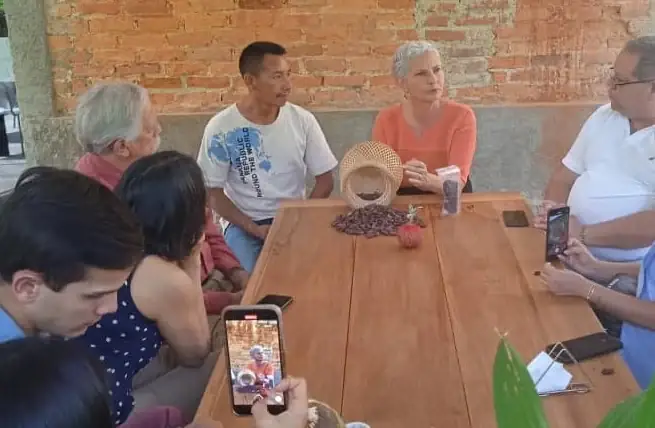
Simeon Moreno was Ekobius’s first caretaker in 2013. His work remains part of the place’s continuing story. A cacao grower with a farm on the upper Paraguaza River, he is a key representative of the producer relationships behind this initiative and holds a 1% interest in Ekobius. He has authorized Ekobius to use his company’s name in this collaboration. Visit his company website
What We Are Building
Our central ambition is an in situ cacao biodiversity research station: a place to study cacao in its ecological setting, connect field observations with local expertise and strengthen the livelihoods that keep living forests valuable. A nursery and a Centro de Acopio are proposed supporting facilities.
How We Work
We seek practical collaboration with the Piaroa, also known as Huottuja or Uwottuja, and the Huottuja Foundation. Each activity requires agreement with the people involved. Producers, knowledge holders, researchers and visitors should understand their roles, compensation and responsibilities before work begins.
An Intentional Community with a New Focus
Ekobius retains its identity as an intentional community and ecovillage. Its isolation, shared property and existing infrastructure create a setting for people who want to live, contribute and build a practical life around common purposes. Research, Indigenous partnerships and sustainable agroforestry now lead its development; community living remains a complementary path. Prospective residents are invited to discuss compatibility, accommodation and responsibilities before making arrangements.
Two Addresses, Distinct Functions
The field property is at Kilometer 24, Vía Gavilán, Concejal Comunal Indígena de Barranco Colorado, Municipio Atures, Amazonas 7101, Venezuela. Ekobius maintains its U.S. business and registered office at Unify Cooperative, 302 General Smith Drive, Richmond, Kentucky 40475, United States. The field and WhatsApp contact is +57 322 671 6433; the U.S. business telephone is +1 859 379 8277.
Publisher, Editor and Webmaster
Unify Cooperative publishes this website and its content. Col. David J. Wright is the editor and webmaster. These publishing and office arrangements are separate from Arol J. Wright’s stated role as executive trustee and owner of record of the Venezuelan property.
An Off-Grid Operation Sustained by Useful Work
The operating plan aims for a sustainable off-grid base supported by meaningful local production, shared maintenance and institutional activity. It envisages three staff positions, including a groundskeeper; employees may be non-members of the cooperative. The project reports an on-site labor planning cost of US$13 per worker per working day, or US$39 for a day when all three positions are staffed. The schedule and any additional employment-related costs are budgeted separately. Employment, compensation and cooperative ownership are separate arrangements. The aim is practical autonomy through work that the local workforce finds worthwhile, with actual staffing and services developed as resources allow. The institutional pool supports this purpose, but ownership percentages alone are not a recurring operating income.
Relationships with Ten Indigenous Communities
The project intends to develop relationships with members of ten local Indigenous communities described by project administration as having 100 or more residents each. The emphasis is on useful production, learning, mutually agreed work and continuing relationships with community representatives. These are relationships to develop and document, not a claim that every community has already signed a partnership or that a property purchase grants authority over its people, territory or knowledge.
Ownership of the Shared Property and Its Enterprise
Investor participation covers the collective Ekobius property and the Ekobius-owned assets, operating rights and net economic results assigned to its cooperative in-formation: cacao research, nursery and agroforestry work, harvest handling, processing, exports and visitor activities. The signed instrument identifies the included assets, liabilities and operating interests. It does not appropriate independent producers’ businesses, Indigenous territory or traditional knowledge.
A Reconciled Register and Protected Commons
The investor offering is 500 tokens (50%); the protected institutional commons reserve is 100 tokens (10%). Legacy residential accounts and the separate development/residential pool are reconciled independently. The original 13% legacy allocation plus 10% Indigenous representatives and 10% commons gives a 33% baseline; adding the investor round gives 83%. If eight legacy 1% interests are lawfully recovered, the baseline becomes 25%, and eight replacement residential interests must be allocated to restore the 83% target after the investor round. Pending cancellations are not completed cancellations and recovered tokens cannot be counted twice.
Audit at 80%; Assembly at the 83% Target
At 800 of the 1,000 tokens actually allocated or protected as commons, owners initiate the accountability audit and post-development valuation. Its informational report is due within 90 calendar days and addresses assets, liabilities, annual production, income, costs, reserves and a proposed distribution policy. The first assembly is planned on the property after completion of the 500-token investor round, attainment of the 83% allocation target and availability of that report. The register controls the calculation; unissued pool tokens do not count. The assembly elects officers, directors and committees and adopts the cooperative’s governing and transfer documents.
From Arol’s Record Title to Cooperative Ownership
Arol holds the present record title while the cooperative is in formation and recognizes investor rights through the executed transaction documents. Following the audit and first assembly, he will execute the agreed transfer of record title and assigned operating assets to the legally constituted cooperative, with the necessary consents and filings at the competent Registro Público in Atures through SAREN. He will retain his personal 1% participation under the agreed structure. Cooperative title, beneficial participation and the members’ register must be reconciled; the milestone alone does not perform the conveyance or cancel existing rights.
Donations, Sponsorships and Ownership Are Distinct
A donor gives without receiving ownership. A sponsor supports an agreed research or infrastructure activity under its own terms. An investor purchases the participation described in the deed, even when motivated by philanthropic support for cacao biodiversity. A US$30,000 payment exchanged for 1% is recorded as an ownership purchase, not wholly as an unrestricted donation. Residential ownership and tourism remain separate programs with their own prices, maintenance and visit conditions.